
The Encounter
Dornonville Soloists — Sydney Opera House, Utzon Room
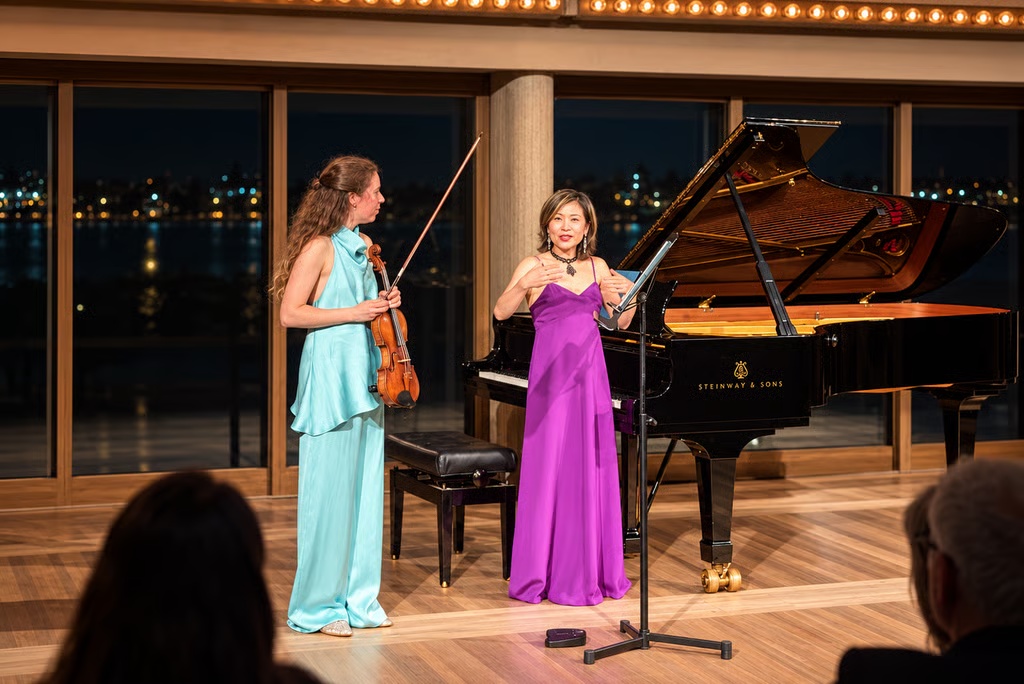
The Utzon Room at the Sydney Opera House provided a beautiful setting for The Encounter, a chamber music concert bringing together violinist Justina La Cour, pianist Marina Saiki and cellist Lara Biancalana under the name Dornonville Soloists.
The evening offered an ambitious journey through late Romantic, twentieth-century and contemporary music, with an emphasis on repertoire that audiences do not often have the opportunity to hear.
From the outset, it was evident that these were three accomplished musicians, united by their dedication to the music and an evident curiosity for artistic exploration. Their individual musical personalities brought something distinctive to the programme, making the evening both engaging and thought-provoking.
The first half was devoted entirely to violin and piano, opening with Guillaume Lekeu's substantial Sonata, which occupied nearly forty minutes. Alongside works by Nielsen, Langgaard and other composers, the programme extended to approximately eighty-five minutes before the interval.
It was a considerable undertaking, particularly for La Cour and Saiki, whose concentration and commitment throughout the demanding first half deserved recognition.
Yet it was during Lekeu's sonata that I found myself reflecting on something beyond the performance itself.
What does an audience actually experience during forty minutes of uninterrupted music?
Most listeners do not consciously follow harmonic development, formal architecture or compositional structure. Instead, they experience music through its emotional movement, its tensions, contrasts and moments of resolution.
Sometimes, an extended composition gradually becomes something closer to an atmosphere than a musical narrative. We stop following its development and simply inhabit its sound.
There is nothing necessarily wrong with that. Music communicates in different ways, and the experience of listening is not dependent upon technical knowledge.
After all, a listener does not need to understand how music is constructed to recognise when it has something to say.
The experience reminded me of the remarkable responsibility shared by composers and performers. A composition may possess considerable artistic substance, but it is through interpretation that its character and expressive possibilities are brought to life.
In this respect, the musicians of Dornonville Soloists had much to offer.
My only reservation concerned the balance of the programme rather than the quality of the performances.
There is so much wonderful music to discover, and the desire to introduce audiences to lesser-known repertoire is admirable. Yet programming is itself an art, requiring careful consideration of duration, contrast and dramatic progression.
Sometimes, choosing what to leave out is just as important as choosing what to include.
With such an extensive first half, I felt that a little more space between the musical ideas might have allowed the individual compositions to make an even stronger impression.
The arrival of cellist Lara Biancalana after the interval brought a welcome change of instrumental colour and musical perspective. Her contribution enriched the evening, creating new possibilities for musical dialogue and contrast.
The concert concluded with Maurice Ravel's Sonata for Violin and Cello, a remarkable work whose intricate musical conversation between the two instruments provided a compelling final contribution.
Its placement at the end, however, left me with one small question.
Given the concert's title, The Encounter, I would have enjoyed a conclusion bringing all three musicians together. After an evening celebrating their individual artistry, such a moment might have offered a particularly satisfying sense of musical arrival.
Of course, there is no rule that a chamber concert must end with every performer on stage. The choice of Ravel was artistically legitimate, and the work itself offered a fascinating conclusion. My observation is simply one of overall programme balance.
What I particularly appreciated was the musicians' willingness to explore repertoire beyond the familiar. At a time when classical music is continually finding new ways to connect with audiences, such artistic curiosity is both valuable and necessary.
The Utzon Room contributed beautifully to the occasion. Its distinctive atmosphere created a direct connection between performers and listeners, reminding us why chamber music remains such a rewarding musical experience.
I left the concert with a genuine appreciation for the three artists and their musical ambitions. While I might have approached the programme's structure somewhat differently, the evening offered much to admire and, perhaps equally importantly, much to think about.
Dornonville Soloists remind us that chamber music is not a finished tradition, but a living conversation — renewed by curiosity, artistic conviction and the courage to explore beyond the familiar.
The Encounter was a welcome celebration of musical discovery, brought to life by three impressive musicians whose artistic curiosity deserves both recognition and encouragement.